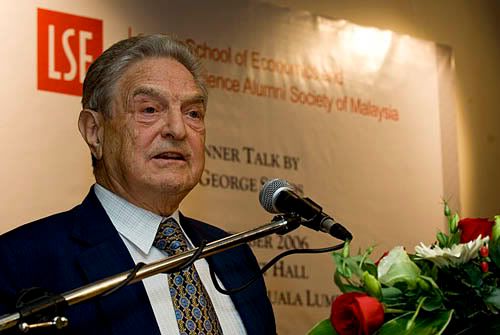
Saturday, 28 June 2008

Against Washington


Why the Washington Consensus does not work.

In the same way that revolutionary socialists argue that Stalin betrayed Lenin or Marx, moderate advocates of capitalism like Soros and Stiglitz argue that the IMF et al have abandoned Keynes’ original vision. It isn’t that capitalism doesn’t work; it is more the case that it hasn’t been tried. According to Stiglitz:

In its original conception, the IMF was based on a recognition that markets often did not work well – that they could result in massive unemployment and might fail to make needed funds available to countries to help restore their economies. The IMF was based on the belief that there was a need for collective action at the global level for economic stability[…]Keynes would be rolling over in his grave if he could see what has happened to his child. (Independent on Sunday, 9 November 2003)

Since the 1980s the IMF, WTO and World Bank have advocated the so-called ‘Washington Consensus’ of fiscal austerity (government spending cuts), privatisation and market liberalisation. Swept along by the neo-liberal counter-revolution against Keynesian economics the consensus argues that for development to occur barriers to the market should be swept away. The policies that failed in 1930s Europe have been exported to almost the entire globe. The Washington consensus argues that the poorest countries in the world should cut government spending and increase taxes to reduce indebtedness. The tax burden should, of course, fall on ordinary citizens; taxes on profits would discourage investment and enterprise. State assets should be privatised as thoroughly as possible, while barriers to free trade should be swept away. Export led growth is also advocated along with the removal of controls on capital. Multinationals are to be welcomed and government regulation slashed to the minimum.

While Soros and Stiglitz are by no means naturally hostile to the US, given their close links with previous American governments, they believe that the Washington consensus, rather than being based purely on market ideology, is also inspired by the interests of an essentially US corporate elite. The Bretton Woods institutions have massive power to impose their free market medicine because if they refuse to give a country a clean bill of health, foreign capital floods out, leading to economic chaos. If a country rejects free market approaches, money floods out, forcing a rethink. By insisting that barriers to the movement of financial capital are removed the Bretton Woods institutions make it difficult for countries to act independently and they become more closely tied to the whims of global financial markets. Indebted countries that reject the consensus are refused financial stabilization deals by the IMF and aid from the World Bank. Even countries that are independent of IMF financial aid are influenced by the institution’s prescriptions. Typically, British Chancellors of the Exchequer and Japanese finance ministers take close interest in the IMF’s annual report of their countries’ financial health.

Stiglitz believes that the emphasis on fighting inflation and reducing debt advocated by the IMF can be appropriate in some circumstances. He suggests that some Latin American countries during the 1980s attempted to print money to spend their way of crisis with predictable results in terms of high inflation, ‘Countries cannot persistently run large deficits; and sustained growth is not possible with hyperinflation. Some level of fiscal discipline is required’. Neither does he reject all privitisation, ‘Most countries would be better off with governments focussing on providing essential public services rather than running enterprises that would arguably perform better in the private sector, and so privitization often make sense’ . Equally, ‘When trade liberalization – the lowering of tariffs and elimination of other protectionist measures – is done in the right way’, so that inefficient sectors of the economy are removed and replaced with more competitive ones, there can be ‘significant efficiency gains’ (Stiglitz 2002: 53). Soros argues that in an ‘ideal world’ the complete removal of capital controls would be beneficial, noting that restrictions to prevent money moving across national borders creates ‘evasion, corruption and the abuse of power’ (Soros 1998: 192). Suggesting that the collapse of the Soviet economy demanded significant change including major privatisation, Soros notes ‘The fact that radical reforms are often radically misconceived does not obviate the need for radical reforms’ (1998: 226).

However both he and Stiglitz argue that these radical market-based policies have been applied in an inflexible and inappropriate way. Stiglitz argues that the Washington Consensus’s obsession with reducing inflation is particularly damaging because it means that some of the poorest countries in the world have to cut spending to prevent prices rising when problems of joblessness and low growth are likely to be far more damaging. In Indonesia, to pick just one example, Stiglitz notes how IMF-inspired cuts to food and fuel subsidies for the poor led to rioting (Independent on Sunday, 9 November 2003).

Privatisation breeds corruption when assets are sold off. Even when clean it often enriches an elite of corporate fat cats. Privatisation during a debt crisis when an economy is in chaos can mean that assets are sold at knock-down prices, which may simply mean that they can be bought up by US corporations who become stronger at the expense of developing countries. In Russia, according to Stiglitz, the swift privatisation of state assets led to their purchase by a criminal class who thereby gained massive political power. Capital liberalisation has reinforced the tendency for democratic decision making to become subordinated to the demands of financial markets. Soros notes that tax burdens have been shifted from firms and financial operators to citizens increasing inequality:

Interestingly, the state’s share of GNP has not declined perceptibly. What has happened instead is that the taxes on capital and employment have come down while other forms of taxation particularly on consumption have kept increasing. In other words, the burden of taxation has shifted from capital to citizens. That is not exactly what had been promised, but one cannot even speak of unintended consequences because the outcome was exactly as the free-marketers intended. (Soros 1998: 112)

A country implementing policies that the financial markets find distasteful may find that they take their hot money and emerging share market portfolio funds elsewhere, causing slump and currency collapse. As well as tying developing countries to the free market agenda of the Washington consensus, capital liberalisation means that such states are more susceptible to movements in global currency markets that can cause sudden shocks to fragile economies:

It has become an article of faith that capital controls should be abolished and the financial markets of individual countries, including banking, opened up to international competition. The IMF has even proposed amending its charter to make these goals more explicit. Yet the experience of the Asian crisis ought to make us pause. The countries that kept their financial markets closed weathered the storm better than those that were open. India was less affected than the Southeast Asian countries; China was better insulated than Korea. (Soros 1998: 192)

Free trade is theoretically beneficial, but opening up an underdeveloped economy to trade has several major drawbacks. It may force down the price of commodities such as sugar or coffee, wrecking the livelihoods of peasant farmers who have little possibility of alternative employment. It can also destroy ‘infant industries’, new industries that have yet to mature and become efficient and will be killed by unprotected exposure to foreign competition. Stiglitz notes that to achieve growth the successful Asian economies such as Hong Kong, Japan and South Korea initially used selective protectionism to allow their industries to take off.

Soros and Stiglitz feel that the advocates of the Washington consensus are remote from the problems of the developing world, act arrogantly and are consistently biased to the needs of the rich.

[M]odern high-tech warfare is designed to remove physical contact: dropping bombs from 50,000 feet ensures that one does not ‘feel’ what one does. Modern economic management is similar: from one’s luxury hotel, one can callously impose policies about which one would think twice if one knew the people whose lives one was destroying. (Stiglitz 2002: 24)

The institutions promoting the Washington consensus act as if they continue to bear the ‘[w]hite man’s burden’ persisting according to Stiglitz with the notion that they always know what is best (2002: 25). Stiglitz and Soros argue that the arrogance of the Washington institutions means that developing countries have little say in their own economic development and policies are imposed from above. Such arrogance inevitably breeds discontent and even where globalisation has the potential to bring benefits; the Washington consensus has fuelled a hostile counter movement. Discontent is met by repression: rubber bullets against starving rioters. As Stiglitz observes:

A common characteristic is: We know best, and the developing countries should do what we tell them to […]They really see themselves as a harsh doctor, giving them the cod liver oil they need, even if they don’t want it. The problem, of course, is that quite often the medicine […] kills the patient. (Independent on Sunday, 9 November 2003)
It is difficult to think of a single example of a country that has gained from the IMF model of structural adjustment. Botswana is often mentioned but commentators but despite enjoying one of the globe’s fastest economic growth rates the Washington consensus has not delivered sustainable prosperity:
The richest twenty per cent of the population earned more than twenty-five times as much as the poorest twenty per cent.[…] Botswana, at twenty-two per cent, has the world’s sixth highest unemployment rate […] One of the few products of Botswana’s increased economic activity which has been widely shared by its poorer inhabitants is AIDS. Women driven into prostitution by poverty are purchased by the truck drivers delivering goods to the elite. (Monbiot 2003: 214)

Argentina, the Washington consensus exemplar from South America, plunged into severe recession after following the model rigorously, with resulting mass unemployment, poverty and chaos.


The nice cartoon is from the Global Policy Forumwho have lots of material on the Washington Consensus worth a click

Wednesday, 25 June 2008

From Keynes to Bretton Woods


Soros, Stiglitz and other establishment critics of neo-liberalism draw upon the work of John Maynard Keynes, who believed in the necessity of managing capitalism, both to provide a fair society and to maintain a capitalist system. During the 1930s Europe and North America were plunged into recession. Economies shrank and unemployment figures mushroomed to millions. The resulting turmoil fuelled the political chaos that lead to World War Two. The conventional ‘liberal’ or ‘classical’ free market economists believed that the economy worked best without government controls and tended to automatically correct any disequilibria. If demand for goods fell, prices would fall too and eventually shoppers would increase demand as they snapped up bargains. If individuals were unwilling to borrow money, interest rates (the price of money) would fall, and if rates fell low enough demand for loans would pick up rescuing the economy. Furthermore if workers became unemployed they could cut their wages until firms found them cheap enough to employ. These market advocates believed that apparently humane attempts to deal with poverty and unemployment such as state welfare benefits would simply make the recession deeper by discouraging wage-setting. Even socialist politicians such as Hilferding in Germany and Snowdon in Britain accepted this orthodoxy. As the years went by and liberal policies of non-intervention were accompanied by deeper recession, conventional economics became increasingly discredited. The only economies that seemed to work were to be found in Hitler’s Germany and Stalin’s Russia.

By the late 1930s the western economies were slowly pulling out of slump and demand rose with employment as war led to large factory orders for guns, planes and assorted military paraphernalia. Nonetheless by the 1940s and 1950s the economic orthodoxy was largely abandoned for Keynesianism. Keynes suggested that economics has a psychological element that means if confidence is low, so too is consumption and growth. Prices, wages and interest rates may be ‘sticky’, by which Keynes meant they would not fall easily, because firms, banks and workers may be reluctant to lower them if they feel that they will still suffer when demand is low. Keynes argued that if people think bad economic news is on the horizon they spend less and the bad economic news becomes a recessionary reality. Businessmen and even women are particularly edgy and suffer from a herd mentality, cutting investment when they fear bad economic news. Like deranged beasts they stampede towards slump. The answer is for governments to inject spending in the economy when recession looks likely. In turn if excessive spending threatens the economy, governments can control it by raising taxes and cutting expenditure.

In July 1944 Keynes acted as the British government’s representative to the Bretton Woods Conference in New Hampshire, USA. Bretton Woods aimed to create a new financial architecture and new global institutions to restore economic stability and remove the threat of world recession, after the war had been won. It called for the creation of three key institutions. During the 1940s the General Agreement on Trade and Tariffs (GATT), now known as the WTO, was established to sweep away barriers to trade so as to promote faster economic growth. The International Bank for Reconstruction and Development, commonly known as the World Bank, was set up to lend money to countries, initially for restoration of infrastructures decayed during recession and smashed by war. Its role has increasingly shifted towards funding development projects in the south of the globe. Finally the IMF was created to help countries faced with severe debt problems or balance of payments deficits. Stiglitz sees all three institutions as essentially Keynesian, examples of government intervention, aimed at making the market work and capitalism expand.

Friday, 15 June 2007

Ch2, pt 2 Stiglitz and Soros


That a self made capitalist, who has clawed his way to unimaginable wealth using the most abstract and advanced tools of unproductive finance such as derivatives and currency deals, is an opponent of the IMF and George Bush, should give apologists for ‘business as usual’ pause for critical thought.


Stiglitz and Soros
Joseph Stiglitz became Chief Economist of the World Bank in 1997. He was also one of President Clinton’s key economic advisors and chaired the US Council of Economic Advisors. His ground breaking academic work on asymmetric information, the idea that markets may fail because consumers and producers have imperfect knowledge, won him a Nobel Prize (Guardian, 11 October 2001). In 1999 he resigned from the World Bank because he felt that the more powerful IMF was blocking its agenda of reform. In 2001 he published Globalization and its Discontents, arguing that neo-liberal globalisation had led to poverty for millions of people and would fail unless thoughtfully reformed. The title echoes Freud’s Civilisation and its Discontents, an explosive tome that shows how apparent rationality is based upon repression. Stiglitz comes closer to endorsing violence against economic repression than any other commentator outside of autonomist anarchism, bitterly observing, ‘For decades, people in the developing world have rioted when the austerity programs imposed on their countries proved to be too harsh...what is new is the wave of protest in developed countries’ (Stiglitz 2002: 3). While the prophets of capitalism ignore or ridicule most of their opponents, they hate Stiglitz with a corrosive passion:
Mr Stiglitz's prose reads like a draft dictated to a secretary whose mind was apt to wander: readers too will be drifting off a lot. Also, the narrative conveys a whining self-righteousness that is always tiresome and sometimes downright repellent. (Economist, 6 June 2002 )

George Soros was raised in poverty, made a fortune and is now best known for using his wealth for ambitious political and social projects. Born in Hungary, his family hid their Jewish origins to avoid extermination by the Nazis and their anti-semitic puppets. In the post-war years Soros found his way to Switzerland, moved to the UK to study at the London School of Economics. In 1956 he left for the United States where he managed to make a massive investment fortune. He specialized in arbitrage, the art of skimming off the differential change in value from dealing, especially dealing in currency. He was an early practitioner in the high risk hedge fund market, an ‘investment of $100,000 in Soros’s Quantum Fund in 1969 was worth $300 million by 1996’ (Hertz 2001: 137). In 1992 he bought billions of dollars worth of foreign currency being sold by the British government to prop up demand for sterling. As the pound slid in value his currency worth accelerated upwards.

Fiercely hostile to the totalitarianism of both Hitler and Stalin, he embraced the free market philosophy of the Austrian philosopher Karl Popper. Soros established the Open Society Institute, his philanthropic foundation, in 1979, ‘to help open up closed societies, help make open societies more viable, and foster a critical mode of thinking’ (Soros 1998: 69). Popper argued that socialism led to a closed totalitarian society ruled by experts. Marx, for Popper, is prefigured by Plato who believed in a utopia governed by an elite of philosopher kings. Yet by 1995 Soros had come to believe that unfettered capitalism rather than socialist totalitarianism had become the main threat to freedom. Such sentiments are summed up in the title of his 1998 book, The Crisis of Global Capitalism: Open Society Endangered which sees globalisation as a force that must be tamed if a market based society is to be sustained.

Soros has advanced his ideas practically by funding an interesting range of charitable projects and political campaigns. He sent four hundred photocopiers to his native Hungary to promote information access in the pre internet era. He allegedly helped to topple the President of Georgia in 2004 and poured dollars into anti-Bush campaigning:
[He] gives away $400m a year through his Foundation and thus subsidizes many of the activist groups, luminaries and publications of the American left, probably dwarfing the sums that once trickled out of Langley or Moscow […] his monetary influence is one of those hushed secrets inside the left usually dismissed as conspiracy-thinking. (Sheasby 2003)

That a self made capitalist, who has clawed his way to unimaginable wealth using the most abstract and advanced tools of unproductive finance such as derivatives and currency deals, is an opponent of the IMF and George Bush, should give apologists for ‘business as usual’ pause for critical thought.

Friday, 8 June 2007

2 VACCINATING AGAINST ANTI-CAPITALISM: STIGLITZ, SOROS AND FRIENDS


well new chapter, on to those Keynesians a bit critical of nasty old capitalism, thought that Hari's description of Stiglitz is silly but rather amusing.


[Joseph Stiglitz] looks like a caricature of a Wicked Capitalist from a Bolshevik propaganda poster circa 1917. You know: the one where a pig-like businessman rests his feet on a perspiring, emaciated worker and spoons caviar into his fleshy gob. Stiglitz is round and portly, with braces to hold up his trousers. He has a big grin, worn on a mouth that looks like it was born to hold a fat cigar. Yet he is one of the most important left-wing economic and political thinkers of our time, and his agenda cuts to the heart of the most urgent moral issue in the world: mass poverty. (Johann Hari, Independent on Sunday, 9 November 2003)

Though these banner-wavers hog the headlines and disrupt the streets, they pose no serious threat to the two Bretton Woods institutions [the IMF and the World Bank] Their goals (such as ‘end capitalism’) are too absurd; their arguments too incoherent. But this year, more than most, the IMF faces criticism from a more serious source – those inside rather than outside the barricades. A growing chorus of insiders, from staff members (sotto voce) to Wall Street bankers (more loudly), is asking whether the Fund and the rich countries that largely determine its policies know what they are doing. (Economist, 26 September 2001)

Along with the black-clad messengers and NGO activists some surprisingly sober figures have been prepared to challenge neo-liberal globalisation. The fact that bankers, economists and speculators are questioning the system that made them wealthy clearly disquiets advocates of unfettered capitalism. While some of these ‘insiders’ criticise the IMF for lack of true zealotry in the capitalist cause, many believe that the globalisation it promotes is socially and economically destructive. Joseph Stiglitz, former Chief Economist of the World Bank and George Soros, perhaps the world’s best-known financier, are the most important, other ‘establishment’ figures have echoed their assumptions that the capitalist market needs careful national and international regulation to function sustainably. The late Sir James Goldsmith, the corporate asset-stripper once condemned as personifying capitalism at its worst, attacked free trade and took on GATT, before it was fashionable to do so, during the 1990s (Goldsmith 1994). James Tobin the economist who argues that speculative flows of capital should be taxed also springs to mind. The Nobel prize winner Amartya Sen is also one of a number of economists who have echoed Stiglitz’s perspective (Sen 1999). The example of John Gray, a former Thatcherite and contributor to the free market Institute of Economic Affairs, is instructive. His detailed and passionate attack on globalisation from the right is difficult for conservatives to answer (Gray 2002). Drawing upon the Austrian social thinker Karl Polanyi, he argues that neo-liberalism leads to social chaos, smashing the bonds of family and community necessary for a stable human order.
These critics argue that US-style capitalism is far less efficient than European or Asian variants. They believe that the Washington consensus of unlimited free trade, privatisation and strong deflationary policies actually prevents capitalism from growing and developing countries from becoming financially secure. They echo the key assumption of the economist Keynes, whose policies helped rescue the post-war global economy from recession and mass unemployment, that government intervention actually makes markets work more effectively. Their critique is not dissimilar to that of Hirst and Thompson who argue from a social-democratic perspective that capitalism can (and should) be reined in by the nation state (Hirst and Thompson 1999). This chapter focuses on Stiglitz and Soros, examines their challenge to economic orthodoxy and shows how their ideas are derived from John Maynard Keynes reformist interventionist economic approach developed in the 1930s.

Thursday, 7 June 2007

Debating apocalypse


Chesterton [the founder of the National Front] combined his anti-Semitism, his anti-Communism, his anti-Americanism and his fervent patriotism and concluded that Jewish Wall Street capitalism was the same thing as Russian Communism. Jewish capital had funded the Bolshevik Revolution of 1917, he believed, and Jewish capital had funded the development and technological base of Soviet Russia. The Moscow-Wall Street axis had its major objective the ruin of the British Empire, the mongrelization of the British race, and eventual world government. The United Nations, NATO and Jewish people were all to be regarded with the deepest suspicion as agents of ‘the money power’. (Walker 1977: 29).

Conspiracies make life easy to explain and provide enemies, the bankers, the capitalists, the US, that are easy to attack.


Well if you have read all the entries, well done...first chapter read, hope it was not too obvious, things step up chapter by chapter.

This section looks at some big theoretical questions that run through book and briefly looks at neo-nazi anti-capitalism from the founder of the National Front, the nasty anti-semitic conspiracy stuff. Not all anti-capitalism is progressive.

Happy reading, friends.

Debating apocalypse
Even a brief survey of the main currents of anti-capitalism throws up a number of difficult debates that demand attention. First, is the issue of what can be crudely termed conspiracy or concept? Are economic concepts just window dressing to help legitimate the power of one group over another? While conventional market economists, the media and most politicians argue that there are enduring economic ground rules that provide a guide to constructing a prosperous future, many anti-capitalists suggest that economics is almost entirely irrelevant as an explanation for the workings of the system. The monetary reformers often argue that bankers control the politicians so as to maintain power over the monetary system. The autonomists believe that the economic system is manipulated to control the working class and exploit them. Many of those concerned with trade, whether localists who want more protection or fair traders who want less, believe that bodies like the WTO are motivated not by a concern with comparative advantage and other economic principles, but simply by a wish to benefit the rich and powerful.

Conspiracies make life easy to explain and provide enemies, the bankers, the capitalists, the US, that are easy to attack. There is little doubt that many of our problems result from those with power exploiting those without. Unfortunately conspiracy does not explain everything. The conspiracy view of economics seems to generate a cartoonish air of unreality. Autonomist Harry Cleaver, to give one example, argued in the 1970s that inflation had been deliberately created by capitalist states to weaken the power of trade unions by reducing the purchasing power of their wages (1979: 95). Yet most commentators agree that deflation where prices fall, rather than inflation where prices rise, is much more damaging to workers because it leads to unemployment. Right wing politicians like Mrs Thatcher have been obsessed with reducing inflation, an unlikely strategy if inflation really did harm the very poorest as opposed to bankers defending the value of their assets. While conspiracies exist activists should also be critical of concepts and should beware stereotyping that delivers an enemy who is satisfyingly easy to label, condemn and attack.

The blame game can shade into a form of pseudo or not so pseudo-racism where entire groups are scapegoated for economic ills (Chua 2003). In the United States politician Pat Buchanan has campaigned against the WTO, arguing along with other far right nationalists that a one world conspiracy exists to limit local diversity. Banking and capitalism are seen as creating a new world order that benefits only rootless cosmopolitans and wrecks nation states. The far right unites with the far left in its choice of conspiracy enemies (Rupert 2000). Martin Walker in his study of the far right British political party the National Front, described a racist anti-globalism:
Chesterton [the founder of the National Front] combined his anti-Semitism, his anti-Communism, his anti-Americanism and his fervent patriotism and concluded that Jewish Wall Street capitalism was the same thing as Russian Communism. Jewish capital had funded the Bolshevik Revolution of 1917, he believed, and Jewish capital had funded the development and technological base of Soviet Russia. The Moscow-Wall Street axis had its major objective the ruin of the British Empire, the mongrelization of the British race, and eventual world government. The United Nations, NATO and Jewish people were all to be regarded with the deepest suspicion as agents of ‘the money power’. (Walker 1977: 29).

A second key issue is that of productivism versus primitivism. Many anti-capitalists would like to see the economy grow essentially forever. The west provides a development model for the rest of the globe. The problem is that the current workings of the IMF, WTO and other global institutions of economic governance is that they prevent real growth. Yet for other anti-capitalists, inspired by the green critique such as the ecosocialists, economic growth, however measured in a capitalist society, will destroy scarce resources, devastate global ecology and impoverish us in a whole range of ways subtle and not so subtle. The debate about growth throws up profound difficulties, it seems like madness to say that developing countries should not grow; yet capitalist growth for a minority already looks unsustainable given problems such as the greenhouse effect. What would the planet look like if car ownership was as high in mainland China as it is today in New Jersey? Perhaps ways can be found of enjoying life and meeting needs without producing more and more for ever and ever?

A third area concerns strategy. Can the global economic system be changed by gentle reform plans or are the problems identified so profound as to demand sudden and even violent change? Is it possible or desirable to describe a utopia, to paint a picture of a world without capitalism? How can a new kind of society be built that delivers prosperity without creating unsustainable environmental damage or crippling injustice? Changing apparently fixed tracks to the future is not going to be easy. Should anti-capitalists build alternatives or focus on blocking what exists and is cancerous?

These issues run through the entire book and must run beyond it. Suffice to say, we need to take history by the scruff of the neck and debate alternatives that genuinely benefit humanity and other species. The literary theorist Terry Eagleton has argued cogently that the most bizarre utopians are those who predict that capitalism can feed the world and continue into the distant future. The soothsayer ‘with his head buried most obdurately in the sand, is the hard-nosed pragmatist who imagines the future will be pretty much like the present only more so […] Our children are likely to live in interesting times’ (Red Pepper, February 2004). While Marx famously taught us to doubt everything, we can be certain that another world is both possible and necessary. Getting there remains the question.

Tuesday, 5 June 2007

Diversity or chaos: Cataloguing different anti-capitalisms


The most militant participants in the anti-capitalist protests have been the anarchists, many are non violent but others participate in the street fighting ‘black blocs’. The anarchists are inspired by diverse thinkers but perhaps most prominently by the ‘autonomists’ such as the academics Harry Cleaver, Michael Hardt and Toni Negri. Like Marx, they argue that globalisation is a product of the most destructive tendencies of capitalism. For them the market is not a means of regulating the economy but a weapon used to imprison workers. They see the work place as a prison and believe that workers’ struggles to escape from the power of capitalism have encouraged firms to relocate globally.
The demands of the movement seem relatively straightforward. Neo-liberal globalisation is delivering poverty, injustice, authoritarian controls and environmental destruction, so demands our opposition. However, a closer look at the movement indicates intellectual confusion and a chaotic mismatch of contradictory assumptions. While it may be difficult to reach agreement on all issues given the diversity of the groups and networks involved, some of these contradictions seem extreme.
An excellent example is the issue of trade. Groups such as Oxfam believe that the removal of tariffs and other barriers to trade will help developing countries. At present the European Union, the USA and Japan heavily subsidise their own farmers and place huge tax on food imports from the rest of the world. A fair trade campaign put together by the NGOs is aimed at removing barriers to trade so countries in the south of the globe can sell more of their agricultural products in the wealthier parts of the world.
Many others in the anti-capitalist movement including farmers from the south of the globe believe that free trade, which after all is the aim of the WTO, will actually create greater poverty and drive them away from the land. Free trade means that large scale western farmers, particularly in the mid West of the USA can undercut small developing country producers and drive them out of business by providing farm products at a fraction of the price. Such fears motivated one Korean beef farmer at Cancun to commit suicide in protest (Guardian, 16 September 2003).
How can advocates of free trade and protectionism be part of the same movement? To an extent, the dichotomy is artificial. The US, EU and Japan have embodied the same contradiction ever since GATT was established in 1947. The US government has campaigned strongly for free trade in agriculture when it has benefited and against when it is not in the perceived US interest. For example, the US, under President Clinton, took the EU to court to force them to end support for small-scale banana producers in the Caribbean because this was detrimental to US multinationals like Del Monte who have large banana plantations in South America. Successive US governments have given huge subsidies to American cotton farmers because this is seen as politically expedient. May be the anti-capitalists could simply advocate protectionism when it helps the south and promote free trade where it brings benefit? Nonetheless, the trade issue is an excellent illustration of the contradictions that the movement must address if it is to succeed in creating a fairer, greener and more democratic world order.
It is possible to disentangle a series of different, although to some extent overlapping, anti-capitalisms. One group whose work under pins the protest and who are examined in chapter two, can be termed ‘anti-capitalist capitalists’. While ‘anti-capitalist capitalists’ are unlikely to be on the streets at major international protest, they are none less important to the movement. They don’t reject the market, greater international trade or economic growth. In the past, they have been prominent supporters of neo-liberalism. As establishment figures who have participated in global economic institutions, they cannot easily be dismissed by advocates of globalisation. George Soros and Joseph Stiglitz are excellent examples. Soros, an international financier who has made millions of dollars from playing the money markets, has come to argue that unrestrained free market forces erode democracy and create social chaos. Stiglitz, who won a Nobel Price for his development of micro economic theory, who echoes many of Soros concerns, is a prominent economist who headed the World Bank and was one of Bill Clinton‘s key advisors (Stiglitz 2002 and 2003).
Others in the movement focus on the destructive role of multinational corporations, arguing that footloose international companies drive down wages, hypnotize us into destructive consumerism and lower environmental standards. Naomi Klein’s book No Logo sees globalisation as leading to a race to the bottom, where countries struggle to lower standards so as to attract inward investment (2000). Multinationals selling brands outsource production to companies that use the cheapest of labour. David Korten, author of When Corporations Ruled the World argue that large corporations should be removed and replaced with a local markets based on family and community run business (2001).
It is possible to contrast those NGOs who support further free trade, albeit in a ‘fair’ context, with those who see trade as damaging. Green localists that free trade will impoverish millions of small peasant farmers and accelerate ecological damage. Colin Hines, who co-wrote The New Protectionists with Tim Lang (1993) and Localization (2000), is representative of such a trend. The new protectionists or localists have also been instrumental in creating the International Forum on Globalisation, a major anti-capitalist think tank and campaigning body. While Hines concurs with many of the concerns of Korten and Klein his emphasis is on the need to build largely self-sufficient local economies. Perhaps the best-known green localist is Caroline Lucas, the charismatic Green Party MEP who with the late Mike Woodin wrote Green Alternatives to Globalisation (2004). The Indian academic Vandana Shiva is another localist. Others such as the journalist George Monbiot have attacked the localists in the movement for ignoring the real benefits of trade and for failing to examine how global economic forces can be democratized(2003). Chapter four deals with green localism.
A section of the anti-capitalist movement focuses on money, banking and debt. The international debt crisis has created the Jubilee movement for debt relief in the South of the globe, while economist James Tobin has suggested that a tax could be levied on speculative flows of currency to create a more stable economic system and to inject some of the money made by financiers back into the real economy. The ATTAC movement, originally formed by journalist from the French newspaper Le Monde Diplomatique but now with branches in many countries has been campaigning with some success for this ‘Tobin Tax’. ‘Social creditors’ and other related ‘monetary reformers’, inspired by the unorthodox theories of figures like Major Douglas and Silvio Gesell see finance as an evil and advocate the creation of debt-free money by the community to generate a different kind of world order (Hutchinson, Mellor and Olsen 2002; Rowbotham 1998 and 2000). The critics of finance capital are discussed in chapter five.
Marxists, other socialists and trade unionists have marched at Seattle and other protests against neo-liberal globalisation. Marxist explanations of crisis are particularly important in discussing the approach of socialist opponents of neo-liberal globalisation including Communits Parties, the Fourth International or Socialist Workers Party (Callinicos 2003; Petras and Veltmeyer 2001 and 2003; Went 2000). The President of Cuba, Fidel Castro has produced a fascinating socialist account of global capitalism (Castro 2002). Some Marxists and ex-Marxists have argued that globalisation may lead to a post-capitalist society and the liberation of humanity. Nigel Harris (2003) and Meghnad Desai (2004) both suggest that Marx argued that capitalism by industrializing the planet would create the conditions necessary to sustain a prosperous socialist society. Marx they suggest argued that capitalism by industrialising the planet would create the conditions necessary for a fair and prosperous society. Chapter six introduces Marxist accounts of globalisation.
The most militant participants in the anti-capitalist protests have been the anarchists, many are non violent but others participate in the street fighting ‘black blocs’. The anarchists are inspired by diverse thinkers but perhaps most prominently by the ‘autonomists’ such as the academics Harry Cleaver, Michael Hardt and Toni Negri. Like Marx, they argue that globalisation is a product of the most destructive tendencies of capitalism. For them the market is not a means of regulating the economy but a weapon used to imprison workers. They see the work place as a prison and believe that workers’ struggles to escape from the power of capitalism have encouraged firms to relocate globally. In Empire Hardt and Negri (2001) argue that a militant movement, the multitude, can over throw capitalism and create a new kind of society. Autonomism is placed in a historical tradition of anarchist economic thought ranging from Kropotkin to the workers communes of the Spanish Civil War. The Marxist and post-modern influences on militant autonomism are also outlined in chapter seven with an emphasis on Empire.
Ecosocialists such as the US Green presidential challenger Joel Kovel (2002) maintain that the best insights of both Marx and the Greens need to be combined if globalisation is to be understood and resisted. For ecosocialists the basic atoms and molecules of capitalist production conjure up debt, multinational corporations, the dislocations of ‘free’ trade and all the rest. For the ecosocialists, analysed in chapter eight, the idea that capitalism must continue to grow and dominate the planet is alien. Chapter eight outlines the case for ecosocialism. Finally chapter nine concludes with a look at how an anti-capitalist economy can be built and sustained.

Sunday, 3 June 2007

Capitalism is ecologically destructive, socially unjust and undemocratic. Discuss.


Slavery, land enclosure, forced labour, colonialism and most of the accompanying rape and pillage is ignored. Capitalism did not evolve gently but emerged covered in blood, splinters of bone and slimy viscera. When things fall apart the results are rarely pretty. The capitalist scholars today are also largely silent when it comes to the creation of new markets in far from democratic states such as Chile under General Pinochet and China. Equally the greenhouse effect, declining fish stocks, the rise of the automobile and the prevalence of low-level nuclear waste suggest that statistics indicating a cleaner environment need questioning.


Capitalism is ecological destructive, socially unjust and undemocratic. Discuss.

Whats wrong with capitalism?
Anti-capitalists vigorously challenge the claims of the market utopians such as Lomborg or Norberg. The modern market is dominated by a tiny number of mega corporations who have scant interest in ‘market forces’ but this is of little concern to advocates of capitalism who have simply invented new economic theories that explain why planning and control by monopolistic multinationals is in the public interest. For example, the Austrian economist Schumpeter has argued that monopolies through a process of creative destructive, where by they invent new patented products to preserve their power, drive economic growth. Other neo-liberals deny that corporations have more power than the thousands of individual firms in competitive markets:
That isn't true. Corporations can acquire monopoly status in a system of tariffs, licensing and coercion, because then consumers are denied the option of buying from anyone else and potential new businesses are prevented from competing. Capitalism means freedom to pick and choose and to reject the businesses which aren't up to scratch. Corporate liberty in a capitalist economy is the same thing as the waiter's liberty of giving the customer a menu to choose from. And the whole point of free trade is that other waiters - even foreign ones - are allowed to come running up with alternative menus (http://www.johannorberg.net/?page=indefense_qa).

The neo-liberals have been more than happy to surf across their contradictions. Planning by governments or local communities is still condemned by the Economist and similar journals as essentially flawed. Most fundamentally, the far from bloodless origins of capitalism are mythologized out of the neo-liberal version of history. Slavery, land enclosure, forced labour, colonialism and most of the accompanying rape and pillage is ignored. Capitalism did not evolve gently but emerged covered in blood, splinters of bone and slimy viscera. When things fall apart the results are rarely pretty. The capitalist scholars today are also largely silent when it comes to the creation of new markets in far from democratic states such as Chile under General Pinochet and China. Equally the greenhouse effect, declining fish stocks, the rise of the automobile and the prevalence of low-level nuclear waste suggest that statistics indicating a cleaner environment need questioning.
Challenging the neo-liberal orthodoxy, anti-capitalists point to a range of problems that have grown with globalisation. Poverty is perhaps the most obvious, despite the fact that neo-liberalism should according to its advocates deliver high levels of growth that reduce poverty, there is much evidence to suggest that income inequality has grown over recent decades. Indeed during the 1990s both absolute and relative poverty have increased.
The World Bank (Economic Outlook 2000) shows that since 1980 the number of people living on less than $2 per day has risen by almost 50% to 2.8 billion—almost half the world’s population. A report from Christian Aid noted that between 1960 and 1997 the gap between the poorest fifth and richest fifth more than doubled, that the top fifth had 86% of the world's wealth, while the lowest twenty percent had just one percent. The wealth of the world's three wealthiest billionaires is more than that of the GNP of all the least developing countries and 'their 600 million people.' Those who argue that globalisation reduces poverty would do well to study the record of the US, arguable the most globalised nation on Earth:
The gap between rich and poor in America is the widest in 70 years, according to a new study published by the Center for Budget and Policy Priorities.
The research, based on newly released figures from the non-partisan Congressional Budget Office, shows that the top 1% of Americans - who earn an average of $862,000 each after tax (or $1.3m before tax) - receive more money than the 110m Americans in the bottom 40% of the income distribution, whose income averages $21,350 each year. The income going to the richest 1% has gone up threefold in real terms in the past twenty years, while the income of the poorest 40% went up by a more modest 11%. (Schifferes 2003).
In the former Soviet Union the creation of a market economy has led to catastrophe. In an article subtitled ‘Russia appears to be committing suicide’, the Economist (2 October) notes that since 1989 the countries population has plunged by several million and is projected to fall from 147 million today to 120 million in 2030. Declining fertility, violence, sexually transmitted diseases, tuberculosis and alcoholism are just symptoms ‘of the long, dark night of the Russian soul ushered in by the disorienting collapse of communism’.

There are number of explanations as to why globalisation paradoxically boosts GNP rates and at the same time pushes up poverty. Globalisation by allowing companies to move easily from country to country means they pay far less tax to governments, which leads to less redistribution. The monopoly power of drug firms has been a major factor in pushing down life expectancy in Africa. Christian Aid cites Mara Rossi, head of the AIDS department of the Catholic Diocese of Ndola, Zambia, who noted "The availability of drugs to treat HIV/AIDS is an example of how globalisation fails to benefit some of the world's poorest and most needy people. Because of the monopoly of multinational pharmaceutical companies, drugs are not available to the majority of HIV infected people in Asia and Africa. These drugs must be made accessible in countries such as Zambia. It's no good promising loans to buy anti-retroviral drugs that in the end will increase foreign debt. The majority of AIDS patients in Africa need clean water and food as well as drugs to treat their illness" (Christian Aid 2000) Neo-liberalism encourages governments to cut welfare programmes in both the south and north of the globe. Subsidies for cheap food have largely gone, increasing levels of starvation. Privatisation has made it more difficult for the poorest to afford basic utility services such as clean water. Welfare benefits have been made reduced or abolished in parts of the globe including the US. Trade unions are under threat. Typically Zhang Junjiu, vice chairman of All-China Federation of Trade Unions (ACFTU) has argued that globalisation makes it difficult for trade unions to protect workers pay and conditions. While the Chinese economy grew strongly in 2004, millions were laid off by state enterprises and multinationals relied on casual workers with low pay. Urban unemployment rose to 8 million. Multinationals can keep moving to countries with low wages, making it difficult for workers in developed countries to maintain employment and for those in poor countries to improve conditions (www.chinaview.cn 2004-10-10).
Democracy is another area of concern for the anti-capitalists, while the number of states with nominally democratic systems has increased, globalisation has robbed voters of much of their influence over governments. WTO rules tend to reduce the sovereignty of local and national government by ruling that much legislation, produced by states, is protectionist and therefore illegitimate. The US government used WTO rules to force EU countries into taking dairy products that contained growth hormones. At present, the WTO is battling to make the EU accept unlabelled genetically modified products, despite the fact that opinion polls suggest that the majority of European citizens wish to be protected from GM. Multinationals who often have more wealth than nations can effectively force countries to reject legislation that may damage corporate interests. Even supporters of capitalism sometimes admit the essentially undemocratic nature of the market, for example, Thomas Friedman author of The Lexus and the Olive Tree, a long hymn to the neo-liberal globalisation, has argued:
For globalism to work, America can't be afraid to act like the almighty superpower that it is....The hidden hand of the market will never work without a hidden fist -- McDonald's cannot flourish without McDonnell Douglas, the designer of the F-15. And the hidden fist that keeps the world safe for Silicon Valley's technologies is called the United States Army, Air Force, Navy and Marine Corps. (New York Times, March 28, 1999)
Poverty is increased and democracy eroded by a process of social dumping or levelling down driven by both the WTO and the multinationals. Countries that reduce governmental controls, taxes and public expenditure attract more investment by international corporations. In the desperate race to attract foreign investment countries have a huge incentive to sweep away forms of social protection such as trade unions rights, maximum working hours and an adequate minimum wage. Despite an ageing population fewer and fewer workers can gain access to adequate pensions from their employers. In countries such as China and the Philippines blandly named Export Processing Zones (EPZs), have been created where manufactures can ignore legislation protecting workers, so as to drive pay and conditions down to lower average total costs.
The anti-capitalists believe that the process of neo-liberal globalisation has concentrated wealth and power into the hands of an ever-diminishing minority. This minority is increasingly US based and uses both global institutions and the US state to cement its dominance. Thus, the existence of the USA as the world’s hyper power is seen as increasingly damaging, allowing a tiny minority of North Americans to shape the world so as to serve their own interests. The growth of capitalism is based on the exploitation of the working class, small farmers and peasants and it largely excludes women from meaningful participation in political and economic decision-making. Racism is part of the process. All but a tiny minority are defined as ‘the other’ and seen as a means of creating wealth rather than as human beings with their own ends: creative, social, cultural and ecological. Anti-capitalists also critique the ethos of capitalism, where local diversity in the arts, cuisine and other aspects of life are driven out creating a homogenized global culture. Everywhere individuals drink Coca Cola, wear Nike and eat McDonalds. The sociologist George Ritzer has created the concept of the macdonaldisation of society to explain how mass production has delivered a world of increasing modular uniformity (Ritzer 1995). Such a capitalist culture breeds alienation, a feeling of homeless in a world dominated by accountancy, which degrades even those who benefit in material terms from the rule of capital.
Ever increasing capitalist globalisation damages the environment by lowering standards of protection and by locking us into an escalating system of waste. The world circles to destruction around a mountain of decaying trainers and trashed soft drink cans. The drive for endlessly increasing international trade means that goods are transported ever rising distances driving up fuel consumption and in consequence, the greenhouse effect. Higher agricultural exports tend to depress prices because of over supply and force farmers to exploit ecologically sensitive and essential mangrove swamps and rainforests. Ever increasing economic growth in turn means that more and more scarce resources are demanded, so as to maintain the profit system. Capitalist growth for the whole planet would demand according to some critics the resources of four planet Earths and such resources would have to grow to maintain the capitalist system into the future (Wilson 2002). Neo-liberals argue that the world is getting cleaner, resources are growing rather than shrinking, poverty is disappearing and democracy is on the rise. The evidence is against them on all these counts.